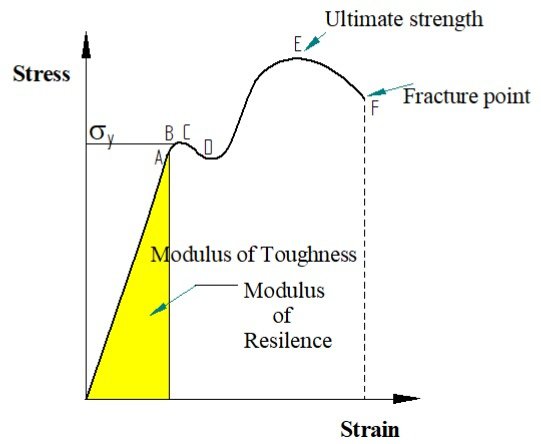
Resilience Definition Mechanical Engineering. The selection of the appropriate mop depends on the specific service provided by the system under analysis. Resilience is the ability of a material to withstand elastic deformation without deforming plastically.
What Is The Difference Between Resilience, Proof Resilience And Modulus Of Resilience? - Quora from www.quora.com
As ‘μ’ it is normally denoted and the limit is the elasticity limit and also some time is donated as ur. Toughness is defined as the ability of the solid. Resilience is the ability of a material to withstand elastic deformation without deforming plastically.
The Branch Of Mechanics That Deals With Bodies At Rest Is Called Statics While The Branch That Deals With Bodies In Motion Is Called Dynamics.
Resilience means that an ability of back to the original shape, or to recover quickly from difficulties. In other words, resilience involves the stretching of atomic bonds prior to the breaking of the bonds. The resilience definition can be further interpreted as the ability of the system to withstand a change
Resilience Is Here The System’s Ability To Absorb Disturbances Before It Changes The Variables And Processes That Control.
Resilience is a capability of a material to absorb the energy. Resilience engineering is about the characteristics of resilient performance per se, how we can recognise it, how we can assess (or measure) it, how we can improve it. So it is the property of a material to absorb energy and to resist shock and impact loads.
Toughness Is Defined As The Ability Of The Solid.
Resilience is defined and measured based on system performance. Proof resilience and modulus of resilience are discussed in this article. Briefly, the strain energy stored in a body due to some external load is known as the resilience where the body is within the elastic limit.
The ‘Ecological Resilience’ Is Defined As The Capacity Of A System To Undergo Disturbance And Reorganize So As To Still Maintain Essentially The Same Functions, Structures, And Controls By Not Moving In A Different Region Of The State Space Controlled By A Diverse Set Of Mutually Reinforcing Processes (I.e., Shift To A Different Domain Of.
Resilience (engineering and construction), the ability of buildings and infrastructure to absorb assaults without suffering complete failure resilience (materials science) , the ability of a material to absorb energy when deformed, and release that energy upon unloading What is resilience in engineering material? The selection of the appropriate mop depends on the specific service provided by the system under analysis.
Senthil Murugan Department Of Mechanical Engineering, Mepco Schlenk Engineering College (Autonomous), Sivakasi, India 1.
Posted on 18th december 2015. If we are talking about stressing the material and having it return to its original state, we are talking about the material remaining in. The two contrasting aspects of stability—essentially one that focuses on maintaining efficiency of function (engineering resilience) and one that focuses on maintaining existence of function (ecological resilience)—are so fundamental that they can become alternative paradigms whose devotees reflect traditions of a discipline or of an attitude more than of a reality of nature.
Share
Post a Comment
for "Resilience Definition Mechanical Engineering"
Post a Comment for "Resilience Definition Mechanical Engineering"